Friday, Wrapped in Paper: A Chip Shop Supper Through Italian Eyes
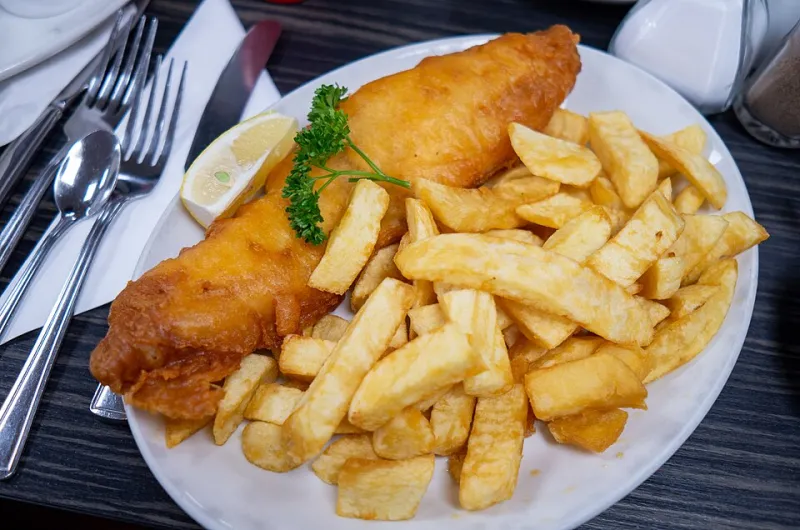
Photo: Matthias Meckel, CC BY-SA 4.0, via Wikimedia Commons
I did not grow up with the Friday chip shop. I grew up with a different sort of paper: focaccia wrapped in greaseproof, a paper cone of fried artichokes, the occasional square of pizza bianca still warm from the oven. So when I first joined the queue outside a British chippy — properly joined it, not peered through the window like a tourist — I understood immediately that I was in the presence of a ritual. The smell hit first. Then the language: haddock, rock, scampi, scraps, salt and vinegar, open or wrapped. It felt less like ordering food and more like being let in on a local password.
That was years ago. The queue has changed, the prices certainly have, and the paper seems thinner than it used to be. But the pleasure has not. If anything, this November, with the nights drawing in and the pavements already cold by six, the chip shop feels less like convenience food and more like civic infrastructure. You do not need a reservation. You do not need to dress. You stand with everyone else, breathe in hot oil and vinegar, and wait.
The queue is not the delay. It is the appetiser.
I have come to think that the queue is the most Italian part of the whole operation. In Italy we are good at waiting when waiting is part of the point: the queue at the bakery on a Saturday morning, the ten minutes before a restaurant opens, the little crowd around a market stall while someone chooses the best peaches. A British chip shop queue has that same democratic hum. Nobody is important. Everybody is hungry. The person ahead of you is discussing the weather with the person ahead of them, and by the time you reach the counter you have absorbed three local news items and the approximate state of the bus service.
That is not inefficiency. That is the appetiser. At home, I have tried to recreate the chip shop supper without the queue, and it is never quite the same. You can fry excellent potatoes in a domestic kitchen, but you cannot manufacture the low-grade theatre of standing under a strip light while somebody shouts an order number. So my advice is simple: if you are going to the chip shop, go to the chip shop. Do not order it to your door and pretend the ritual has travelled. Some things are meant to be collected.
What the chip shop gets gloriously right
The first thing is heat. Proper chip-shop chips are not merely cooked; they are dispatched. They arrive in your hands so hot that you have to carry the parcel like a small, delicious bomb, shifting it from palm to palm on the walk home. The second is salt. Not a timid pinch, but a proper scattering that lands while the oil is still hissing. The third is vinegar, sharp and almost aggressive, cutting through the fat in a way that makes you reach for another chip before you have finished the first.
And then there is the paper. I love the paper. It steams the chips gently, softens the batter, collects the vinegar at the bottom in a little puddle that is, frankly, the best part. It is not elegant. It is not meant to be. It is food that understands it is being eaten on a sofa, or out of the wrapper on a bench, or standing up in the kitchen because you could not wait another minute.
Italians would recognise the logic even if they would not recognise the menu. We are a nation of fryers too: artichokes, courgette flowers, olives, small pieces of fish, potatoes. We understand that hot oil is a seasoning. We understand that salt is not a garnish. What we might gently suggest is that vinegar is not the only acid in the cupboard.
A squeeze of lemon is not an insult
Here is the case for lemon. Chip-shop vinegar is wonderful — malt vinegar has a sweet-sour, almost beery depth that lemon cannot copy. But lemon brings perfume. It lifts the batter and the oil without shouting over them. A wedge squeezed over the top of the paper, before you start eating, adds a bright edge that makes the whole parcel taste somehow lighter. It is not a replacement for vinegar. It is a second voice in the choir.
Then there is olive oil. Not on the chips in the shop — please, not in the shop, there is no need to cause a scene — but at home. If you are making a chip-shop-inspired supper in your own kitchen, finish the chips with a very small thread of good olive oil after the salt. Not enough to make them greasy. Just enough to add a green, fruity note that sits surprisingly well next to the malt vinegar. It is the kind of small, cheap improvement that feels almost cheeky.
And if you are having fish, a lemon wedge on the side is not a decorative afterthought. It is the difference between a heavy supper and a lively one. The same goes for mushy peas: a little olive oil stirred through at the end, a crack of black pepper, and suddenly they taste less like a side dish and more like something someone actually thought about.
Building the supper at home without the gimmick
I am not going to tell you to make tempura-battered haddock with saffron vinegar and call it a chip shop. That would be silly. The point of this supper is not to improve the chip shop. It is to borrow its pleasures for a night when you are cooking at home and want something hot, salty and uncomplicated.
Start with the potatoes. Maris Pipers are reliable, but any floury potato will do. Cut them into thick chips, not matchsticks. Rinse them, dry them properly — wet potatoes are the enemy of crispness — and cook them twice if you can: once in lower oil to soften, then hotter to colour. If you are oven-baking, parboil them first and rough up the edges in the pan with a little oil and salt. They will not be chip-shop chips, but they will be good in their own right.
For the fish, keep it simple. A fillet of haddock or cod, dried, seasoned, dipped in a straightforward batter of flour, water and a little beer if you have it, then fried until crisp. If frying feels like too much, a baked fillet with a crumb is perfectly acceptable. This is meant to be a Friday supper, not a exam.
The important bit is the finishing table. Put out malt vinegar. Put out lemon wedges. Put out good olive oil. Put out flaky salt. Let people dress their own. That is the Italian instinct I would bring to the British chip shop: not to take over, but to offer a little more. A little more acid, a little more perfume, a little more choice.
The chip shop does not need saving. It does not need a redesign or a rebrand or a Michelin star. It needs to be left alone to do what it does: feed people quickly, generously and with a certain salty cheer. But at home, with a lemon wedge and a bottle of olive oil on the table, you can have a version that nods to both kitchens. One is British, one is Italian, and neither has to win. That, to me, is a very good Friday.