Ask for the Shin: A Butcher-Counter Map to Italian Cooking
The first time I asked a British butcher for veal shank for ossobuco, he looked at me as though I had requested a unicorn’s hoof. He was polite about it. He offered me beef shin instead, a thick, marrow-boned piece that looked like it had done a hard day’s work. He was right. I was the one being precious.
That is the thing about cooking Italian food in a British kitchen. You can spend your life hunting for the exact cut named in a recipe, or you can learn the language of the counter in front of you. The second approach is cheaper, kinder and, frankly, more Italian. Italian cooking has always been local and practical. It bends to what is available. So should we.
Start With the Pot, Not the Name
Most Italian classics are not fussy about the precise anatomical name of the meat. They are fussy about fat, collagen and time. A slow ragù wants a cut that collapses. A braise wants something with a bit of gristle that will turn to silk. A cutlet wants tenderness and a bone for flavour. Once you know the job the meat has to do, the British counter opens up.
The mistake is treating an Italian recipe as a legal document. It is not. It is a set of instructions written by someone standing in a different shop, in a different country, with a different animal in front of them. Your butcher is not failing Italy by selling you beef shin. You are simply cooking with the animal you have.
Beef: Shin, Rib and the Long Braise
For ossobuco, beef shin is my first ask. It has the marrow bone, the tough connective tissue and the deep flavour that a long, gentle braise can turn into something generous. Ask for thick slices, roughly 3cm, and do not let anyone trim away the bone or the surrounding fat. That is the point.
For a ragù that will sit on the hob for a Sunday afternoon, ask for beef chuck or braising steak, coarsely minced or diced small. If you can get the butcher to put it through the coarse plate, do. Supermarket mince is often too fine, which gives you a sauce that tastes like meat paste rather than meat. A pound of beef chuck and a pound of pork shoulder, both coarse, makes a ragù with backbone and softness.
Short rib is another useful British cut. It is not a traditional Italian name, but it behaves like the beef used in a long brasato. Ask for it on the bone if you can, then cook it slowly with wine, bay and a little tomato. The bone gives the sauce a savoury depth that no stock cube will replicate.
Pork: Shoulder, Belly and the Sausage Problem
Pork shoulder is the workhorse of Italian home cooking in Britain. It makes ragù, it makes meatballs, it makes a rough porchetta if you butterfly it and stuff it with fennel, garlic and rosemary. Ask for it boned and rolled, or boned and tied, depending on what you are doing. Keep the skin on for roasting. Italian pork cookery is not afraid of fat.
Pork belly is your friend for a lazy porchetta-style roast. Score the skin, salt it well, roll it around herbs and cook it low and slow. It is not the same as a whole suckling pig from a hillside in Lazio. It is still excellent, and it will feed a British family on a Sunday without a trip to a specialist importer.
The sausage question is where things get tricky. Italian recipes often call for salsiccia, a plain pork sausage seasoned with fennel and pepper. British supermarket “Italian-style” sausages can be sweet and herby in a way that tastes more like a pizza topping than a butcher’s sausage. Buy plain pork sausages from the butcher, split the skins, and add your own fennel seed and chilli. Or ask the butcher to make you a batch with fennel and no rusk. Most will, if you give them notice and do not ask on a Saturday morning.
And a word on pancetta. If a recipe calls for pancetta, do not reach for smoked streaky bacon. The smoke will take over the whole dish. Ask for unsmoked pancetta if the counter has it. If not, unsmoked streaky bacon is a better substitute than the smoked stuff. Guanciale is harder to find, and I would rather you use unsmoked pancetta than pretend smoked bacon is the same thing.
Lamb, Mutton and the Sunday Pot
British lamb is one of the great ingredients of these islands, and it maps neatly onto Italian slow cooking. Shoulder, on the bone, is perfect for a long roast with potatoes, garlic and rosemary. It is not abbacchio, the young lamb of Rome, but it is close enough in spirit. Mutton, if your butcher has it, is even better for a slower, deeper braise. Ask for it and see what happens.
Lamb’s liver is another quiet winner. Sliced thin, dusted in flour and cooked quickly with onions and a splash of vinegar, it makes a British version of fegato alla veneziana that costs very little and tastes of something. Ask the butcher to slice it for you. They will do a better job than you will at home with a blunt knife.
Chicken: Thighs, Bones and Cacciatore
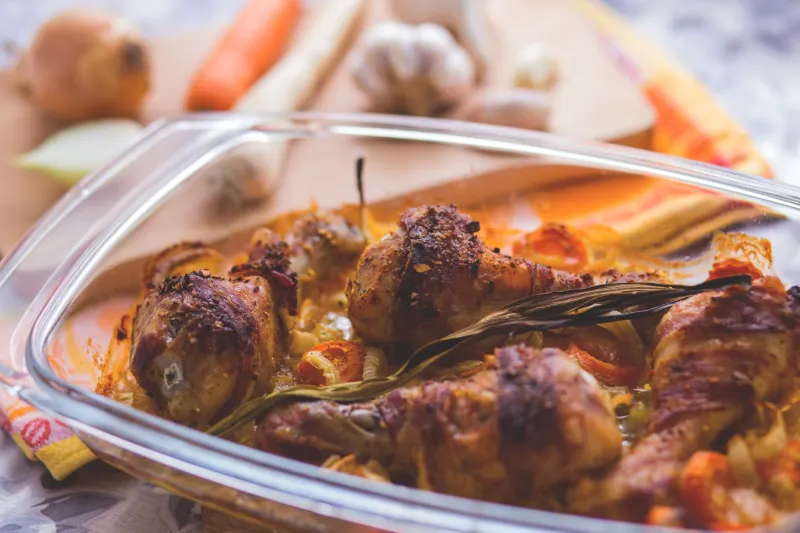
For chicken cacciatore, do not buy a pack of boneless breast fillets. Buy thighs, bone in, skin on. The bone gives the sauce body and the skin gives it richness. If you can only find a whole chicken, ask the butcher to joint it into eight pieces. It takes them thirty seconds and saves you a wrestling match at the sink.
Keep the carcass. Keep the wing tips. Keep the neck if it comes with the bird. These are the makings of brodo, the Italian broth that sits underneath so much of the cooking. A chicken carcass, a beef marrow bone, an onion, a carrot, a celery stick and a couple of hours at a bare simmer will give you something far better than any stock cube. Ask the butcher for bones. Most will give them to you for a pound or two, or throw them in if you are a regular.
The Ask: What to Say at the Counter
Be specific, but not pedantic. Say what you are cooking and how long it will cook for. “I need something for a slow braise, about three hours, with a bit of bone and fat” is a better sentence than “I need ossobuco.” The butcher will point you to the right thing. Ask for coarse mince. Ask for unsmoked. Ask for bones. Ask them to leave the fat on. These are not difficult requests. They are the normal language of a butcher’s shop.
When to Stop Translating
There is a point where translating every cut becomes a hobby rather than a help. If you have beef shin, pork shoulder, chicken thighs, lamb shoulder and a bag of bones, you can cook most of the Italian repertoire that matters in a British kitchen. You do not need to chase veal shank or guanciale or a particular breed of Tuscan pig. You need to cook with confidence and adjust.
That is the Italian soul of it, really. Not the exact name on the label, but the willingness to make something good from what is in front of you. Your butcher is not a gatekeeper to Naples. They are a person with a sharp knife and a cold room, and they can help you cook beautifully if you ask the right questions. Ask for the shin. Ask for the bones. Then go home and cook.